Sunday, August 31, 2014

AMNEP in Hanoi: Day 2

The second and last day of AMNEP  still is very interesting.

Due to the quality of speakers and ideas of the morning session, I am very certain that all participants have learnt a great deal on civil society organisations in South East Asia. The key challenges among women in South East Asia were substantially discussed by Professor Aurora Javater and Sally Moyle. Both speakers shared their experiences and interpretations of women's health, social issues and economy in our region.

The afternoon session was my highlight of the trip! It's the day we share some findings from the project and will launch the project's policy brief for NGOs and key Governmental and civil society organisations. Our workshop is set up for NGOs and delegates from different organisations who are interested in development in Mekong countries.


The panel includes Dr. Francisco Montiel from the United Nations Women, Tanja Van de Linde from Oxfam Novib and me. We met in the morning and discussed some commonalities among our projects and we need to be certain that the participants will be able to learn certain aspects of women's economic empowerment from our projects.


I shared our research findings and challenges for women in Lao PDR and the effects of mining industry on women and their communities. Our policy brief is obviously useful for participants and they we find that some recommendations from our project can be influential and interesting for NGOs and civil society organisations in Mekong region.
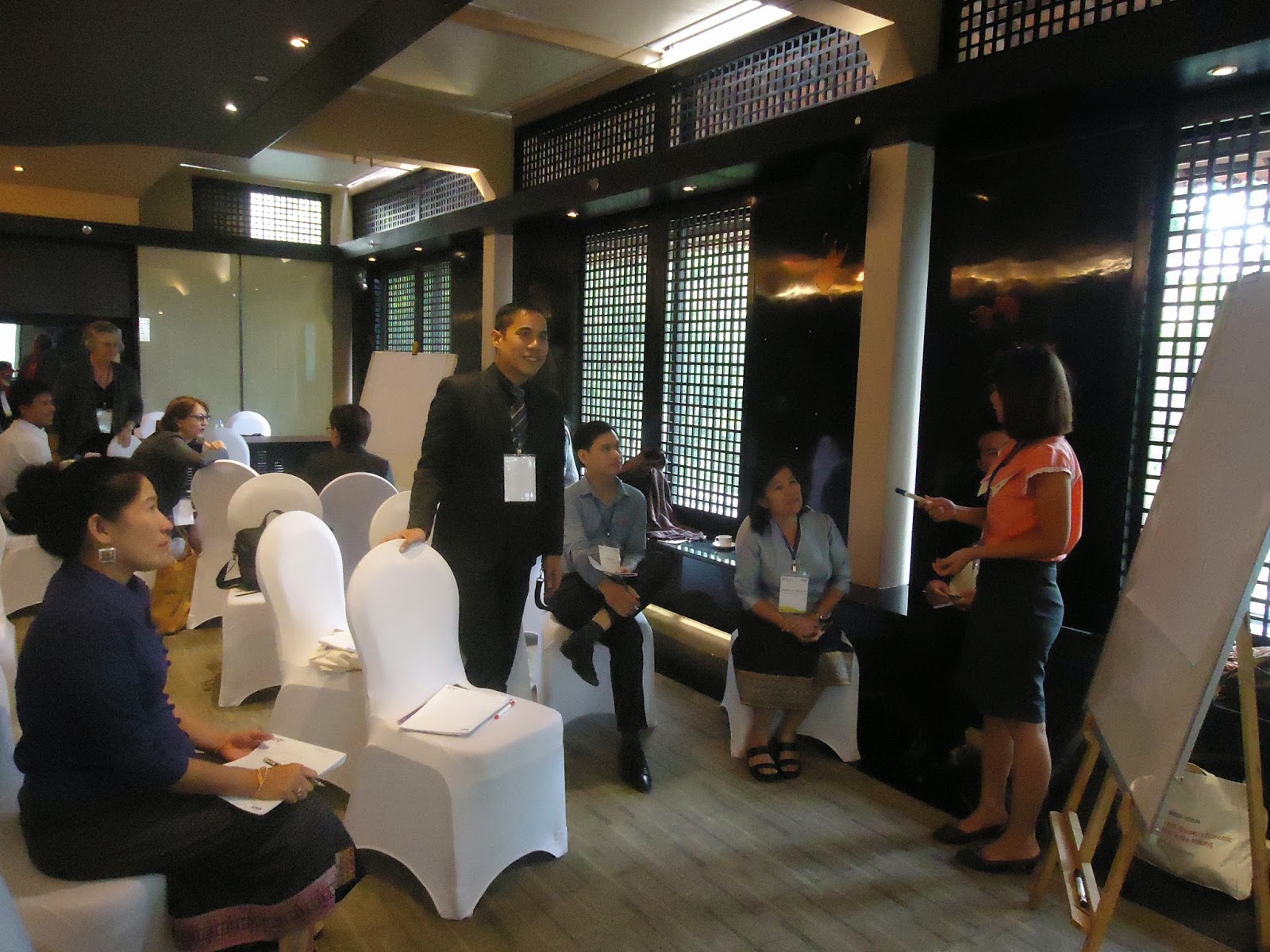

we also worked with the participants on the development of ideas and suggestions for the Australian AID on (1) implications for ASEAN Economic Community (AEC) and women in AEC, (2) opportunities for women in the region, and (3) future of economic activities.


The  conclusion of second AMNEP forum was led by questions o the future of Mekong countries and the ways in which NGOs, local and regional Governments can work together for the future of this area.

I really hope that we will be able to return to the 3rd AMNEP and discuss key comparative points from our research project with participants from various organisation. This year is truly a great year for AMNEP and we need to thank DFAT for their support for all participants.

Wednesday, August 27, 2014

AMNEP in Hanoi: Day 1

I am currently attending the Australia Mekong Non-Government Organisation Engagement Platform (AMNEP) in Hanoi. This is the second AMNEP but I am imprssed by the quality of engagement among NGOs (health, economic, skills and various other sources) and DFAT. Since our project is funded by DFAT (Australian AID), we are pleased to be invited to share outcomes from the project and to launch policy brief from this project at this important platform.


There were approximately 400-500 people at the forum. Ms. Vanessa Wood from South East Asia Regional Branch DFAT (who was also my mentor at the ASEAN Australia Emerging Leader Program) greeted all participants with warmth. Vanessa confirmed the objectives of the forum and how important for the participants who work in NGOs, research and development in Mekong region to meet and share our views and practices. More importantly, with the launch of AEC in 2015, we need to come together to understand key regional challenges.

The morning session was filled with important messages and ideas from top speakers including HE MR Hugh Borrowman (Australian Ambassador to Vietnam), HE Dr. Ing Khanthaphavy (Minister for Women's Affairs from Cambodia), and Gillian Brown.

We spent quality time to discuss key issues such as relationship between women's economic empowerment and educational development in South East Asia. We also heard some outstanding initiatives in Cambodia from Dr. Ing, and some stories on women and workforce in the CLMV countries.  The key challenges in my opinion is differences in women's level of education and training among ASEAN countries. Though a number of women are in the labour force in CLMV countries, few of them have the levels of education and skills that their counterparts in other ASEAN countries have. Very challenging for us in development (and academic).


In the afternoon, there were three parallel workshops (women's civil society, SMEs in Mekong, and methodology to measure and evaluate impacts of women's economic empowerment). I attended the methodologies workshop, due to its proximity to my research project. Again, I learnt some ideas on the measurement of social economic impacts from NGOs delegates and built some ideas and actions with them. By the end of the session, our team proposed a strong message that the evaluation and measurement of economic empowerment is sensitive and we need to take diversity among ASEAN countries into account.

   After a long fruitful day, we were invited to the reception hosted by HE Mr Hugh Borrowman at the Australian embassy in Hanoi. His residence is such a nice colonial style house and I was overwhelmed by hospitality from the Australian AID and DFAT team in Hanoi.


This reception was a great event to chat informally with my new friends from various NGOs from Cambodia, Laos, Myanmar and Australia. I strongly feel that I have made more than connections...I have made friends whom I will work with in development and academic project.


AMNEP ...  What a great forum to meet people! I will share more stories from our day 2 and the conclusion of the forum.


Sunday, August 10, 2014

Preparation for the Australia Mekong NGO Engagement Platform (AMNEP)

We are invited by one of the orginasers to participate at the forthcoming Australia Mekong NGO Engagement (AMNEP) Platform in Hanoi, Vietnam. This program will be a forum for NGOs and not-for-profit organisation working in Mekong areas to meet and discuss key development issues. The key agenda for this round is ASEAN economic integration and women. This is obviously a great opportunity for our team to present some findings from this project to NGOs and delegates from the Australian Aid.
I have prepared an abstract for our presentation and eager to share them with you here.


Mining & Development in Lao PDR 
"The extractives sector, including international mining companies, drives trade, economic growth and development in the Greater Mekong Sub-region by creating jobs and boosting government revenue. Yet investment in the extractives sector in developing countries comes with many challenges.
 There is evidence to show that it is women in mining communities who can have the greatest positive influence on the local economy. Empowering rural village women is vital to unlocking local development.
 This study explores how an international mining company operating in rural Lao PDR engages and influences women, directly and indirectly, and the consequent social and economic impacts on the local community.
 This Australia Aid funded ADRAS research addresses important questions about employment participation and sustainable rural development in Lao PDR. Using a qualitative approach, the authors conducted personal interviews with 76 women and men, and group interviews including key community leaders, from seven villages in Vilabouly District, Savannkhet Province.


The preliminary findings of this study confirm that the international mining industry, in this context, can influence women in three major domains. They include (1) relationship with other members in the community, (2) economic power and social status, and (3) self-actualization. This study also confirms that key actors associated with a rural mining community -  multinational corporations and their shareholders, local government and policy makers, and affected village communities – can potentially work together to promote gender equity and empower women in a rural area in Lao PDR."

We will keep you updated with the event which is scheduled in late August. 

Friday, July 4, 2014

Our Analysis in Forbes Magazine (Thailand)

After the fieldwork in Laos, I received a copy of Forbes Magazine (Thailand) where we published a Thai article on corporate social responsibility and multinational corporations (including Mining) in Asia. The article is an analysis from our literature review and we plan to write a final piece to Forbes by the end of this year.


If you are interested to read this article (and can read Thai), this is the link to our article.
 http://www.slideshare.net/nattpimpa/forbes-36646572

Thursday, June 26, 2014

Data Collection in Laos: The Epilogue of this Trip

We finally reach the end of our fieldwork in Laos. Our last day of the interview started with three personal interviews with three women from different villages and used to work in the mining industry. It was very interesting for me to interviewed a woman who just resigned from the company and support her partner to work overseas. The gender impacts are quite prominent from her story, due to issues on gender roles, expectations and equity issues. One interesting point raised by her is the future of her town after the end of mining MNC in Laos. It sounds like a common fear among community members. We heard the same issue from our focus group interview with six people from the village. Apart from generic comments on socio-economic and environmental impacts, the future of this town remains unclear among the members of this community.

                                                Our Conversation on Mining and Gender

One important point that we learn from today's interviews with Laos women in this community is the meaning of mining industry to the community. Apart from economic gains (as publicly known in many cases), mining industry can also promote equity by means of education, training and social status. Most women who work in the industry agreed that they feel comfortable about themselves. They are proud to be able to generate income and being able to associate with mining MNC. When they work in this industry, it also promotes they status in the family and community.


                                          Miners are the key clients of SMEs in Vilabouly

Before we left Vilabouly, our research visited the office of the Vilabouly's Chief to farewell and thank him for his support throughout the time we spent at Vilabouly. We shared with him our reflections from the field and our connections with the community. He also thanked us for our interests in his town and he really hopes that findings from this project will influence actions from stakeholders in international mining industry.

                                                          Office of Vilabouly District

We left Vilabouly with a number of different feelings. To me, as a researcher, I have learnt new experiences on community issues and how mega-million international business influence various issues in the community. I also learnt practices and protocal of research in Laos. It truly is one of the most exciting learning experiences for me. I worked and traveled with great team members from the National University of Laos, Nossal Institute for Global Health, Burnet Institute and had a great opportunity to connect with many interesting people from the community.


                                                               Vilabouly from the Top

I strongly suggest researchers in my area to think about the impacts of mining industry on development. We have learnt a number of interesting lessons from countries such as South Africa, Australia, Chile, Laos, Vietnam etc. We seem to struggle to find the best ways to promote long-term development for the community in the host countries. We really hope that the next step of this project will also be meaningful for stakeholders, particularly the local community, in this study.

                                                                    Local Market


                                                             Vilabouly Cultural Hall

Wednesday, June 18, 2014

Mining and Gender Research: Methodology Issues

Research methodology is an important issue for our team.I n the middle of our research fieldwork at Vilabouly, our team members think very carefully about some methodological issues. We understand that conducting a research fieldwork on gender and mining can be very sensitive from both political and industrial sides in Lao PDR.


As a researcher, I certainly have learnt a great deal of research practices and protocol from the fieldwork and I would like to share some thoughts with you.
1)    Don’t Let Terms such as ‘mining’, ‘gender’ or ‘community’ Mislead You! I learn that sometimes we tend to have pre-judgmental perceptions when we think of such terms. I had to tell myself to be neutral and try to seek truths from the participants’ perspectives. Sometimes when I started the interview with questions on mining and gender, I had to think very carefully about not to lead the common perceptions of generic mining industry that we always hear in the media.

2)    Be Honest with Everyone in the Entire Research Process! You will work with people at different roles and responsibilities when you conduct research. In Laos, we have to deal with a number of government officers from different levels and agencies, NGOs, communities, villagers, shop owners, workers, men and women from different ethnic groups etc. They need to know the ideas of your research. Make sure you can communicate your research with them very succinctly, clearly in the simple language.

3)      Language, Language, Language! As a Thai speaker who informally learnt Laos, I expected no major problems in conducting personal and group interviews. Oh! I was wrong! In these 6-7 villages, diversity is a key characteristic. You will work with Bru, Phu Thai, Laos Theung speakers. Vientiane accent will be useful but not entirely helpful! Make sure you have a translator next to you when you go to the community. I had 2 translators and that’s been really helpful.

4)      Working the Politics of Research!  I learnt from my colleagues from the National University of Laos that we need extra times to work with several Governmental agencies, chief of district, heads of different villages. The fact that gender can be really sensitive, our objectives must be clearly communicated to all Governmental agencies and the communities. Gender is not a brand new issue in Laos and most women are aware of this issue. However, when you add the complication of international mining industry in to this equation, our ideas (questions, points and issues) must be clearly communicate.

5)       Be Flexible with the Data Collection! Miners work at different times and hours. Do not force them to come to you but you need to be flexible with them. In mining industry, people work at different levels and jobs. Most women in our study work as cleaners, admin. persons and unexploded ordnance persons. We have to be flexible with time and ready to adapt our schedule, language and approaches.
There are a lot more points to share. These points strike my thoughts as potential ideas to develop into a research methodology paper in the future.
I would like to share the feelings of our team on ‘methodology’ in the form of ‘photostory’ and we hope that this story will help you to understand complex issues of doing research on gender and mining.  

Sunday, June 15, 2014

Mining and Sustainable Model: Ban Boon Kham and Non Som Boon

 We returned to Ban Non Somboon to listen to some personal stories regarding the relationship between the communities and mining multinational corporations (MNCs). After The interviews with two men (villagers who also work in mining industry), we can confirm that their concerns regarding the future of the village and their job security are prominent. Since this village is not very large, the residents also ponder alternative jobs such as service work in Savannakhet town. Still, most people may need to stay in the village and never want to be in another town where they are not familiar with.
                                                    Ban Non Som Boon
 From this point, our concern is the future of Vilabouly. We need to know more about the plan of Vilabouly residents and other stakeholders such as mining MNCs, the Governmental body, women groups and youth groups. One point that we learn from most interview is an option on agricultural and farming skills can be one potential solution. To understand this issue, we organize to visit mae Saipon from Ban Boong Kham and seek to understand her sustainable model.
  
                                Mae and her farm in the mining community

We arrived Ban Boon Kham in the morning and visited her Hydroponic farm and agricultural business. Mae told us that she was interested in working in the mining industry but the opportunity was not there for her. Women can only do certain things in mining industry and she had no interests in those jobs. She has always been interested in business. One day, she was part of the tour to Vientiane and had an opportunity to visit a hydroponic farm there. It was the day she saw potential business with the mining industry. What next?  She contacted the company and informed them that she needs to set up a modern vegetable farm and supply her products to the company. It’s not only for her but for the village. MMG agreed with the idea and employed an agricultural expert to teach her village on how to run hydroponic farm. Unfortunately, she was the only person who attended and successfully completed the training.
 
                                                 Hydroponic 'Salad'
 

The company also suggested her to work with other 14 representatives from different villages to be the key suppliers for fresh food for the company. In forming this group, she can also buy vegetables and fruit from the community and resale them to the company. The relationship between her and mining MNCs has been really strong. In her own terms “mining company has endless needs for food.”

                                                                Her Pig Farm

                                                                Poultry Farm
We learnt from her that not all villagers are interested in this business for a number of reasons such as not access to funds, not understanding of the business model, and lack of connections to the suppliers and understanding of markets. She has agreed that mining MNCs can co-ordinate their efforts with someone like her and the leaders of the community to support villagers to live sustainable life, regardless of income from mining industry.
 I left her farm with some feelings when I think about the future of the industry and the village.