Tuesday, January 13, 2015

Australia and New Zealand Academy of Management Conference

The Australian and New Zealand Academy of Management (ANZAM) was founded in 1985 to advance management education, research, and practice in Australia, New Zealand, and beyond.  ANZAM is the primary professional body for management educators, researchers and practitioners in Australia and New Zealand, with about 600 individual members and 50 institutional members (representing most Australian and New Zealand universities) as well as members from other countries.
ANZAM offers Professional and Associate Membership to individuals who are management educators, researchers or practitioners, and Institutional Membership to tertiary providers of management education and research.
The 2014 ANZAM conference is the latest forum where we disseminated our project on mining and gender equity in Lao PDR and Thailand. Our team presented two papers from the project. The main paper entitled "How Mining MNCs promote Gender Equity: Modus Operandi?" focuses on gender-related CSR strategies from mining companies in this study as well as the impacts of international mining industry on women, family, community, and the locals. 

                                                   With keynote speaker, Bob Carr

The presentation was well attended by academicians and researchers in international business, sustainability and development.  The key questions after the presentation include:
1) What will be the key strategies for mining MNCs to promote women?
2) Why MNCs need to focus on equity?
3) What are the roles of local governments in the research process?
4) What I am interested to do after this phase of the project? Why?

These questions are relevant to what we are doing and what we plan to achieve. Since we are approaching the final stage of this project, we hope that we can proceed to the analysis of the project and ways to transfer findings from this project into policies and meaningful practices. 

Tuesday, November 4, 2014

Presentation of the Project at the 2nd Thai Australian Business Studies Conference

After the return from our fieldwork in Thailand, we had to prepare to host a Thai-Australian Studies conference at RMIT University. The idea of the conference is to bring together delegates who are interested in business and community development from ASEAN nations and Australia.


Our research team also hosted a conference dinner with RMIT's Centre for Business Education Research on the first night of the conference. The dinner was well attended by delegates from Burapha University, Chulalong korn University, Monash, RMIT and the University of Melbourne.


At the second day of the conference, we organised a forum on gender and mining industry and shared our experiences on mining and development project with DFAT, our field trips in Lao PDR and Thailand. We also presented preliminary findings from Thailand, focusing on stories from Tub Klor and relationship between mining MNC and women in the community. The presentation was well reviewed and attended by young researchers from various disciplines.


At the end of the 2nd Thai Australian Business Studies conference, we were confirmed by a number of participants that the value of our research project can go beyond economics and management area. In fact, those from health, cultural studies and community development also show strong interest in the project and help us to think of new directions to promote this project to policy makers in Australia, Thailand and Lao PDR. 
 

Wednesday, October 15, 2014

Data Collection in Thailand: Meeting with the Community

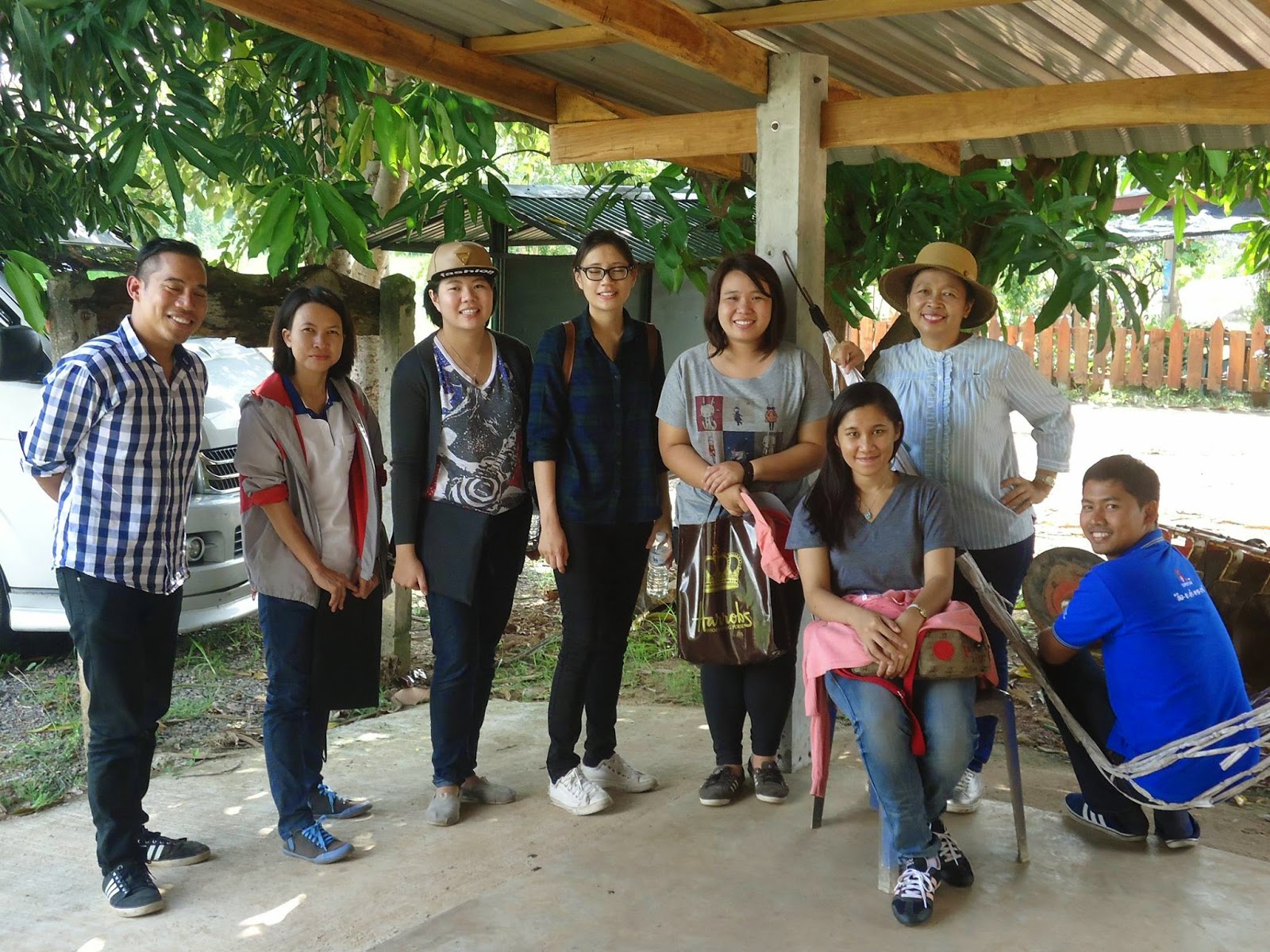
Our team in Thailand is quite a large team from Thammasat and Mahidol Universities. In this project, we also employed seven postgraduate students from Mahidol University to help us in the data collection process in Pijit. This particular aspect of the project fits in the scope of the Australian Aid's research strategy very well since we also aim to empower young scholars to be more familiar with the research process and its complications.


We started our second day at the house of head of village (Poo Yai Ban). Similar to our experiences in Laos, meeting with Poo Yai Ban is very important and courteous. It is important that we introduce our project and its objectives to the leader of this community. I can see a bit of hesitation at the first 20 minutes, due to some sensitive issues in the community.  Poo Yai ban explained several community issues and how nmining MNCs work with the community to promote issues such as community development, environmental criticisms, job and employment, educational development and health issues.  Indeed, the relationship structure between this community and mining MNC is truly interesting.

We also visited the community's meeting (at the central Sala ) and listened to the community stories from various perspectives. My first interview was with some representatives from the sewing group, a vocational group mainly for women (YES! it means men are allowed to join  this group). A number of relationship issues emerge from our discussions. Some stories on how women group works with mining MNCs in Thailand. Some stories from the community perspectives can be very interesting for those who are interested in the sociological perspectives of the community.

Thursday, October 9, 2014

Data Collection in Thailand: Day 1

We have made it to Thailand!!!

After months of planning and management of the project, our team arrived Pitsanuloke and Pijit this month. Our team in Thailand is a true multi-disciplinary team. Apart from Dr. Suphat Supachalasai, an economist from Thammasat Univertsity, we have been incorporated by Dr. Pilaipan from Mahidol University and her team. 

We met at the hotel to discuss the concept of community and some gender issues which are the key points from this study. We realized that common potential issues can be community's perspectives on development and its meaning. Thus, our team decided to follow some key iterviews

It is our hope that this fruitful trip will help us to academically understand of mining MNCs in this study.

Sunday, September 28, 2014

The 5th International Conference of the Asian Rural Sociological Association (ARSA)

This project has created attentions not only in Australia, but also in Lao PDR and Thailand where our team has been working closely with the industry and the communities.
  

From 1-5 September, the National University of Laos (NUOLS) hosted the 5th International Conference of the Asian Rural Sociological Association (ARSA). One of the key organisers, Associate Professor Kabmanivanh Phouxay, discussed our project with international delegates from the region. Since the theme of the conference is  From Challenges to Prosperous Future in the Rural Asia, the key findings from the field in Vilabouly were well received by participants at the conference.  


                                                   Assoc.Prof. Phouxay at ARSA conference


The organiser of this conference, the Asian Rural Sociological Association, has been promoting the international conference to promote better understanding on the sociology of rural development in Asia. The Asian Rural Sociology Association (ARSA) was an offshoot of Asian Rural Sociology Working Group (ARSWG) which was set up in 1992 by a group of Asian participants attending the World Congress of International Rural Sociology Association (IRSA) in Pennsylvania State University, USA.


Saturday, September 27, 2014

Presentation for the Centre for Sustainable Organisations and Work, the Sustainability

Nattavud Pimpa, Timothy Moore, Sheree Gregory and Brigitte Tenni presents International Mining and Development: How Multinational Corporations Promote Gender Equity

Sponsored by the Centre for Sustainable Organisations and Work, the Sustainability Seminar Series explores critical debates and issues from a wide range of disciplines. Though diverse, the series is connected by Centres key research themes: Work, Sustainability and Organisations, and Globalisation.

Event details
Event:
International Mining and Development: How Multinational Corporations Promote Gender Equity
Date:
26 September, 2014
Time:
3 pm – 4:30 pm
Location:
RMIT University, Building 80 Level 07 Room 06 (445 Swanston Street, Melbourne)
RSVP:
Email amrutha.sakuru@rmit.edu.au (Places are limited. Registration and attendance is free)

Thursday, September 25, 2014

Capacity building Workshop: Communication for Research in Development

ADRAS project is unorthodox. When we think of other research project, ideas of publishing your research in top tier journals (AKA A*, A journals) might be project's priority.
In this project, apart from publishing and sharing the results to academic community, the Australian AID (DFAT) also suggested us to promote ideas and actions on capacity building with partners in the project. The impacts can and will be positive and perhaps larger.
In order to achieve this objective, I represent our team to Cholbri in Thailand to organise a capacity building workshop for 26 novice researchers and PhD. students at the Graduate School of Commerce, Burapha University. The focus of the workshop is communicating and disseminating research in business and community development.


Our team created contents and curriculum for this workshop from our current research on mining and development in Laos and Thailand. We worked with all participants to engage them to think about ways to create impacts from your research. I used a number of examples from international and local conferences that I attended to promote our project, meeting with the local authorities and media, writing and promoting policy brief to NGOs or civil society organisations, publishing in some journals and magazines, and being on social media.

The day was full with interesting conversation and ideas among participants who promise to engage their community and disseminate their developmental projects to various communication channels. We also created a network of developmental researcher where I will return to Burapha University and meet with them to listen to the next phase of their research plan.

Our team sincerely thank the Graduate School of Commerce at Burapha University to be very co-operative and supportive. We hope that this network will promote the concept of sustainability in the mining sector in Thailand.